Look beyond the packaging without assigning the cause
Changing the wrapper is a useful investigation step when white PP meltblown discolors in storage. It does not establish why the original change occurred, and continuing yellowing does not automatically prove a resin problem.
Phenolic substances can enter a storage system from external components, while a phenolic antioxidant may already be present in the resin or another material input. Heat, oxygen, processing history and pollutant exposure can also matter. Separate the source of a substance, the reaction that changes color and the exposure that enables it.
Stabilized PP does not always mean phenolic-stabilized PP
PP needs an appropriate stabilization system for its processing and intended use. Hindered phenolic antioxidants are widely used as radical scavengers, often with secondary stabilizers such as phosphites that act on hydroperoxides. The actual package depends on the grade and application.
Do not assume a PP meltblown grade contains hindered phenolic antioxidants. BASF and Clariant document non-phenolic or phenol-free stabilization systems for relevant PP and fiber applications. Their existence does not establish that a particular meltblown grade uses one, or that it will suit a specific line or electret function.
Ask the resin and masterbatch suppliers what they can confirm about the actual grade. A formulation may be proprietary; a documented chemistry statement and suitable color/process data are more useful than demanding a recipe. Antioxidants can be transformed or consumed during processing and aging. Residual additives and reaction products may remain; neither their amount nor distribution can be inferred from a photograph.
Antioxidant transformation can create color
Original research on polyolefins has shown that certain quinoidal oxidation products of hindered phenolic antioxidants absorb visible light and contribute to color. This supports a possible material-side discoloration route. It does not mean that every phenolic antioxidant, every package or every storage condition produces visible yellowing.
Thermal or oxidative transformation and NOx-related gas fading should be described separately. NOx is an external exposure that can interact with a phenolic system already in PP; it is not confined to a BHT-containing packaging film. Published PP fiber stabilization work reports formulation-dependent gas-fade behavior.
That distinction matters in an investigation: an internal additive source may still need an external exposure to produce the observed change. Conversely, discoloration may involve other polymer degradation, contamination or colorant effects. A general chemistry explanation is not a diagnosis of a particular roll.
A pattern is an observation, not a chemical fingerprint
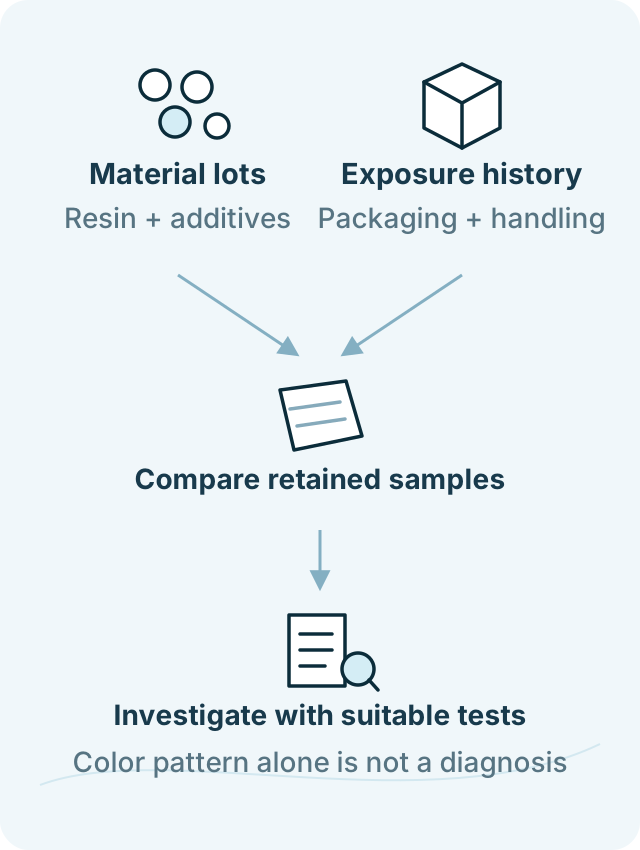
Record whether discoloration is local or widespread, which layers are affected, when it appears and which lots share it. These observations help choose samples. Uniform yellowing does not establish an internal source, and patchy yellowing does not establish a packaging source.
A change that follows a resin lot warrants a material and process review, but resin lots may also differ in thermal history, other additives or contamination. A wrapper change can change contact and exposure as well as chemistry. The changed variable is a lead, not proof of a specific molecule.
- Retain affected and unaffected web, resin and additive lot references, and the actual wrapper, tape and liner information.
- Keep production conditions and exposure history documented when comparing material inputs or packaging.
- Ask a qualified laboratory to design appropriate controlled comparisons and chemical analysis where needed; use replicates and retained references.
What a phenolic-yellowing screen can and cannot tell you
ISO 105-X18:2007 describes assessment of phenolic-yellowing potential in textile materials. Its public scope excludes the many other causes of yellow discoloration. Confirm the applicable method, edition and specimen suitability with the buyer and laboratory.
A result under a phenolic-yellowing challenge is not a measurement of the source of phenolics in a stored roll. It does not prove that the complaint was caused by internal antioxidants, identify the actual packaging as the source or measure general thermal-aging resistance.
Use the report alongside packaging evidence, processing records and investigation samples. Do not convert its conditioning time into a storage lifetime or treat a passing grade as a guarantee that the web will stay white.
Five questions for the material supplier
A supplier discussion should lead to traceable evidence for the selected grade and end use. A confident answer alone is not validation.
- What can you confirm about phenolic and non-phenolic stabilization in this resin grade and the other additive inputs?
- Which test data relate to white or light-colored web, and are the specimens and lots identifiable?
- Which processing conditions, packaging and aging or gas exposure were used in the comparison?
- What stabilization, processability and finished-media trade-offs were checked when the package changed?
- Which requirements will be agreed before a trial, including color and any filtration or electret function?
Prepare an application review
Share the grade and lot identifiers, when discoloration appeared, the affected layers, packaging history and available reports. For charged filtration media, include the charging process and finished-media requirements. Baibang Materials can review the application information and the evidence still needed.
A proposed material change should be evaluated using its applicable TDS and representative results. Grade availability and suitability need confirmation for the actual application.
Sources and method scope
- BASF — antioxidant functions — Manufacturer explanation of primary radical scavengers and secondary hydroperoxide decomposers; supports general chemistry, not a meltblown-grade formulation or performance result.
- BASF — Irgastab FS 301 technical information — September 2021 manufacturer technical sheet retrieved as indexed text; direct PDF open failed. Describes a non-phenolic stabilizer system and PP fiber/nonwoven applications. Demonstrates alternatives exist; not evidence of Baibang supply or meltblown/electret suitability.
- Clariant — antioxidants for polymers — Manufacturer product page read 9 Oct 2026. Describes phenol-free stabilization for PP/polyolefins. Product claims are manufacturer statements, not independent validation or Baibang evidence.
- Original research — transformation products and colour in polyolefins — 1991 Polymer Degradation and Stability original research; accessible publisher abstract reviewed, full text not accessed. Studies quinoidal antioxidant oxidation products and color in PP/PE; does not diagnose stored meltblown or supply a practical concentration threshold.
- US4929653A — PP fiber gas-fade stabilization — Original patent description reviewed. Supports reported NOx discoloration and formulation-dependent gas-fade behavior in pigmented PP fibers. Patent examples and claims are not independently replicated evidence for the supplied meltblown grade.
- ISO 105-X18:2007 — phenolic-yellowing scope — Official public abstract read 9 Oct 2026; complete paid procedure not accessed. Scope assesses phenolic-yellowing potential and excludes other yellowing causes. Official page shows Published and stage 90.20 (under systematic review). Confirm the applicable edition with laboratory/buyer at use; undated lifecycle stage links are not evidence of withdrawal.
This is an investigation guide, not a diagnosis, formulation recipe, lot certificate or performance guarantee.